



Schneeherstellungsdüsentechnologie: Wie künstlicher Schnee hergestellt wird
Über 80 % der Skigebiete sind heute aufgrund der Klimaschwankungen auf Kunstschnee angewiesen. Die Technologie konzentriert sich auf spezialisierte Schneeherstellungsdüsen, die Wasser durch präzise Atomisierung und Keimbildung in Schneekristalle umwandeln. Das Verständnis dieser Düsen offenbart die Technik, die ganzjähriges Skifahren ermöglicht.
- 1. Was ist eine Schneemachdüse?
- 2. Der Keimbildungsprozess
- 3. Temperatur- und Luftfeuchtigkeitsanforderungen
- 4. Wasseratomisierung & Tröpfchenkontrolle
- 5. Luft-Wasser-Mischung & Konfiguration
- 6. Energieeffizienz
- 7. Arten von Schnee-Düsensystemen
- 8. Materialauswahl
- 9. Wartung & Optimierung
- 10. FAQ
- 10.1. Welche Temperatur benötigt man für künstlichen Schnee?
- 10.2. Wie funktionieren Nukleationsdüsen?
- 10.3. Schneepistolen vs. Schneelanzen?
- 10.4. Energieverbrauch?
- 10.5. Beste Düsenmaterialien?
- 10.6. Kann man über dem Gefrierpunkt Schnee erzeugen?
- 10.7. Ersatzfrequenz?
- 11. Fazit
Was ist eine Schneemachdüse?
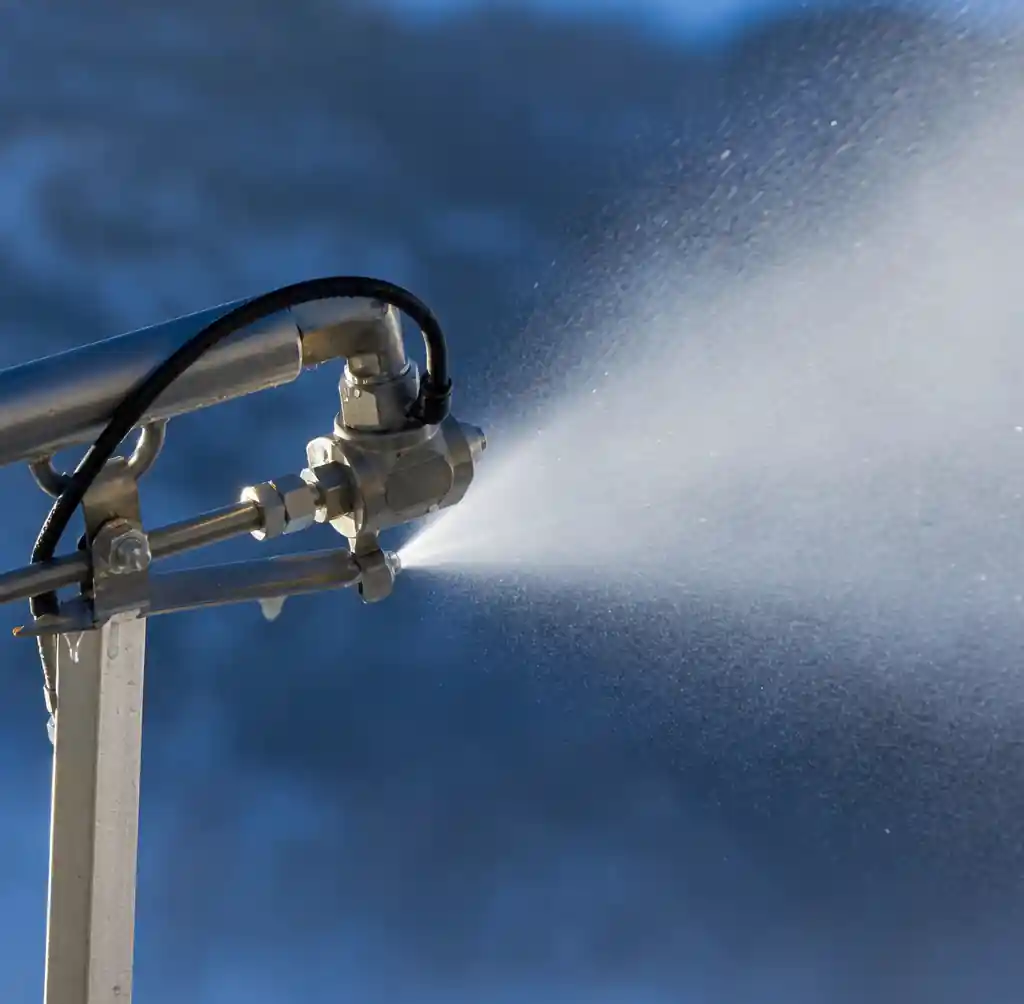
Schneebereitungsdüsen sind präzise Sprühgeräte, die Wasser in ultrafeine Tröpfchen zerstäuben und die Bildung von Eiskristallen erleichtern. Sie arbeiten in Systemen, die Hochdruckwasser (30–50 bar), Druckluft und Gefriertemperaturen kombinieren.
! 1-Schnee-machen-Düse-Nah-Atomisierung Schneeherstellungsdüse zeigt Wasseratomisation und Sprühmuster
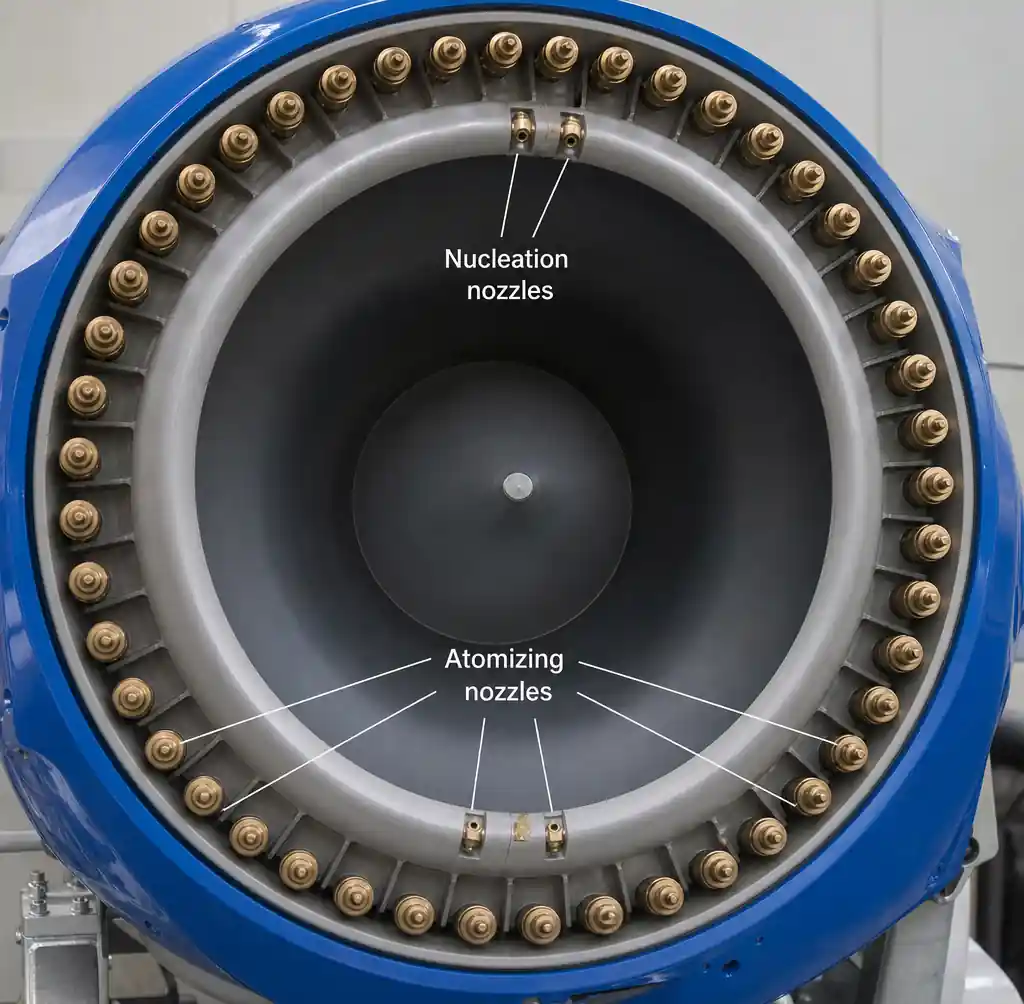
Im Gegensatz zu Naturschnee friert Kunstschnee flüssige Wassertropfen ein. Düsen verwenden zwei Mechanismen: Nukleationsdüsen, die 30–70 Mikron-Tröpfchen für Eiskerne erzeugen, und Atomisierende Düsen, die 100–500 Mikron-Tröpfchen sprühen, die in kalter Luft gefrieren. Diese Düsen finden Sie weltweit in Schneepistolen, Lanzen und automatisierten Systemen.
Der Keimbildungsprozess
Keimbildung ist die Grundlage der Schneeherstellung. Nukleationsdüsen erzeugen 30–70 Mikron-Tröpfchen, die aufgrund des hohen Oberflächen-zu-Volumen-Verhältnisses schnell gefrieren und Eiskristalle bilden, die Schneeflockenbildung begründen.
! 2-Keimung-Düse-Eis-Kristallbildung Keimungsdüse erzeugt ultrafeine Eiskristalltropfen
Diese Tröpfchen frieren innerhalb von Millisekunden ein. Das Nukleationsgerät integriert Druckluft und Wasser in spezialisierten Kammern und erzeugt Eispartikel, die größere Tröpfchen aussäen. Nukleationsdüsen arbeiten bei höheren Drücken – 5–8 bar Luft und 30–40 bar Wasser – für ultrafeine Atomisierung.
Temperatur- und Luftfeuchtigkeitsanforderungen
Der kritische Parameter ist Feuchtkugeltemperatur, die Lufttemperatur und Luftfeuchtigkeit kombiniert.
| Nassbälltemperatur | Qualität | Ausgabe | Bedingungen |
|---|---|---|---|
| Unter 26°F (-3,3°C) | Ausgezeichnet | High | Ideal |
| -3,3 bis -2,8 °C | Sehr gut | Gut | Standard |
| -27-28°F (-2,8 bis -2,2°C) | Gut | Moderat | Effizient |
| -28-30°F (-2,2 bis -1,1°C) | Fair | Begrenzt | Marginal |
| Über -1,1°C (30°F) | Arme | Minimal | Nicht praktikabel |
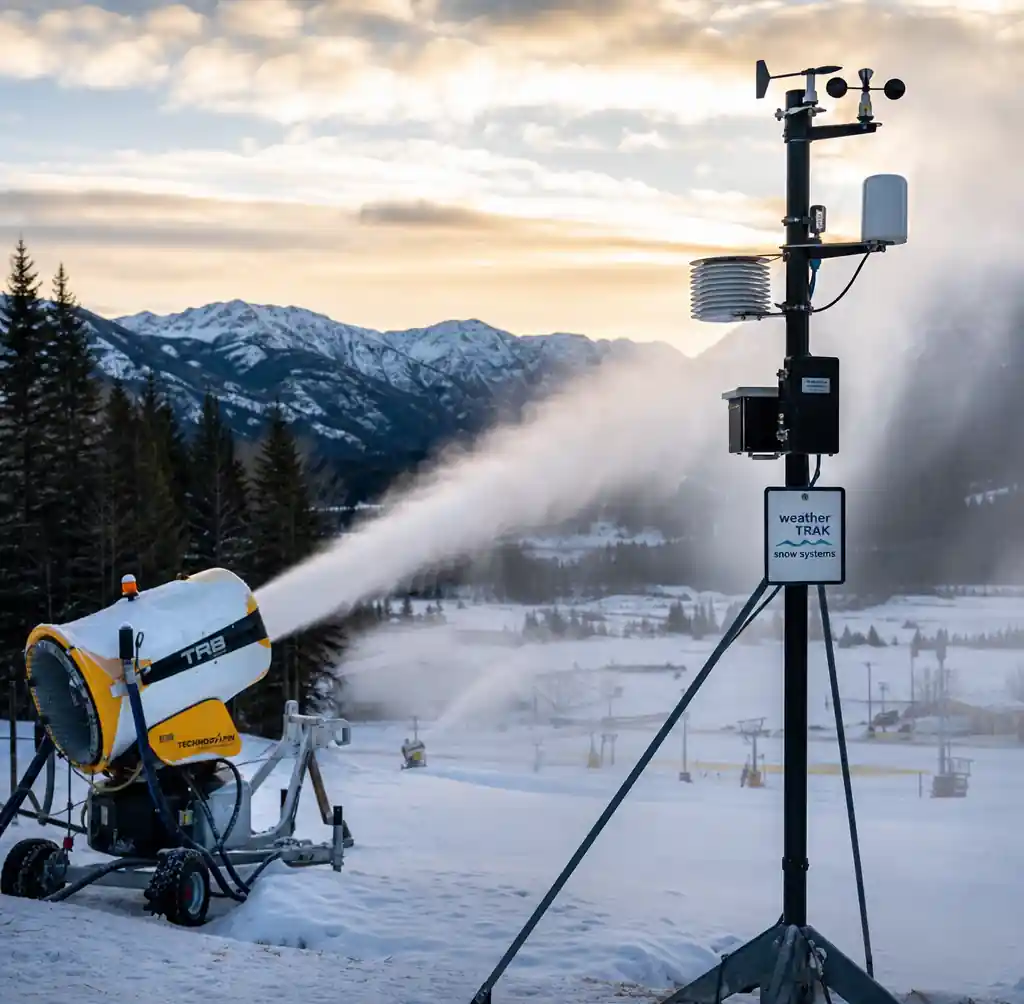
Für eine effektive Schneeherstellung ist eine Nassbauch unter -2,5°C (27,5°F) erforderlich. Niedrige Luftfeuchtigkeit ermöglicht Schneebereitung über 0°C (32°F), während hohe Luftfeuchtigkeit bei 28°F dies verhindern kann. Moderne Systeme verwenden automatisierte Wetterstationen zur Echtzeitoptimierung.
! 3-Ski-Resort-Schnee-Betrieb-Wetter-Bedingungen Skigebieten-Schneeherstellung mit Temperatur- und Wetterüberwachung
Wasseratomisierung & Tröpfchenkontrolle
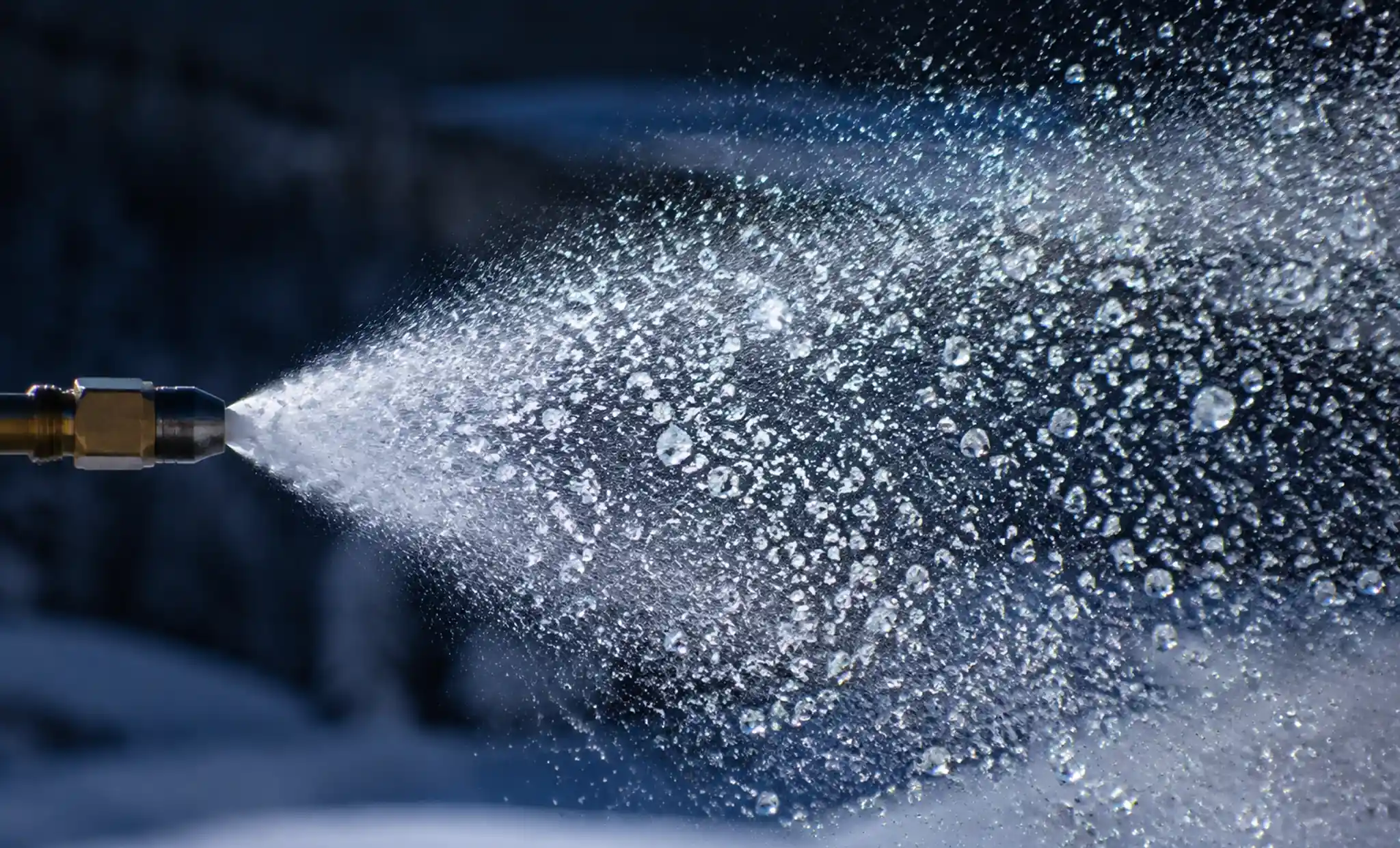
Die Atomisierung zerlegt Wasser über hochgeschwindigkeitsreiche Luftströme in feine Tröpfchen. Schneebereitungsdüsen verwenden luftunterstützte Atomisierung und erzielen feine Tröpfchen bei niedrigerem Druck als herkömmliche Methoden.
! 4-Wassertropfen-Atomisierungs-Sprühmuster Wasseratomisierung zeigt unterschiedliche Tropfengrößen im Schneeherstellungsprozess
Standard-Atomisierungsdüsen erzeugen Tröpfchen im Wert von 100–500 Mikrometern; Nukleationsdüsen erreichen 30–70 Mikrometer. Kleinere Tröpfchen frieren effizienter ein, da das Verhältnis von Oberfläche zu Volumen höher ist. Optimieren Sie die Tröpfchengröße, indem Sie den Wasserdruck (30–50 bar), den Luftdruck (4–7 bar) und den Öffnungsdurchmesser anpassen. Ein höheres Luft-Flüssig-Verhältnis verringert die Tröpfchengröße, erhöht aber die Energiekosten.
Luft-Wasser-Mischung & Konfiguration
| Konfiguration | Luftdruck | Wasserdruck | Tröpfchengröße | Anwendung |
|---|---|---|---|---|
| Keimbildung durch interne Mischungen | 5-8 Bar | 30-40 Bar | 30-70 μm | Eiskern |
| Externe Mischungs-Atomisierung | 4-6 Bar | 30-50 bar | 100–300 μm | Primärschnee |
| Ventilator-Typ Spray | 4-7 Bar | 35-50 bar | 150-500 μm | Breite Abdeckung |
| Stock/Lanze | 5-7 Bar | 40-60 bar | 100-400 μm | Feste Türme |
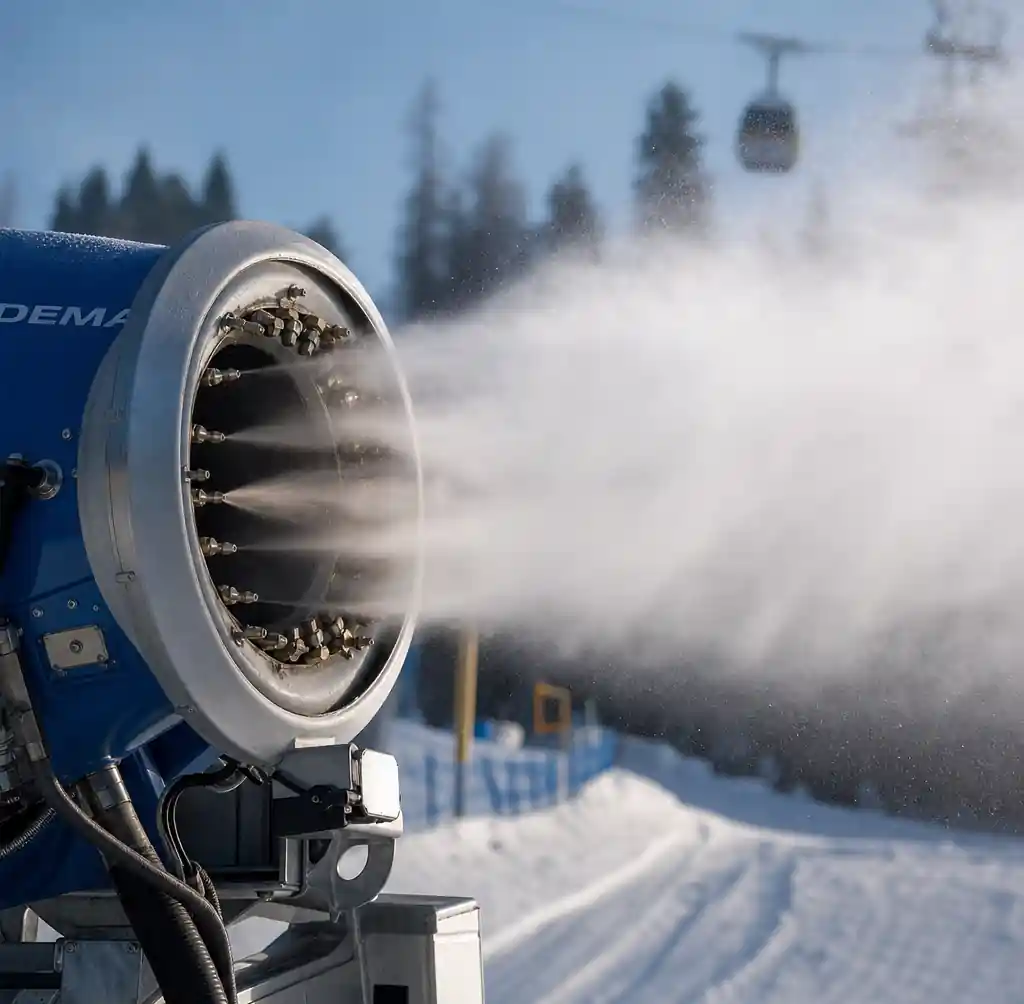
Interne Mischdüsen verbinden Luft und Wasser im Inneren für eine überlegene Zerstäubung. Externe Mischdüsen halten sie getrennt, bis sie aussteigen. Das optimale Luft-Flüssig-Verhältnis (ALR) beträgt 0,3–0,8 – ein Gleichgewicht zwischen Feinatomisierung und Energieverbrauch. Moderne Schneepistolen verfügen über 3–6 Nukleationsdüsen und 8–20 Zerstäubungsdüsen pro Einheit.
! 5-Schneepistole-Mehrfach-Düsen-Konfiguration Schneekanone mit mehreren Düsenkonfigurationen sowie Keimungs- und Atomisierungsdüsen
Energieeffizienz
Die Schneeherstellung verbraucht jährlich 14.000 bis über 1,7 Millionen kWh. Primärverbraucher: Wasserpumpen (40–50 %), Luftkompressoren (40–50 %), Hilfspumpen (10–20 %).
! 6-modernes-hocheffizientes-Schneebereitungssystem Modernes, hocheffizientes Schneebereitungssystem mit energieeffizienten Düsen
Hocheffiziente Düsen reduzieren die Energie um bis zu 80 %. Wichtige Verbesserungen:
- Fortschrittliche Designs bis zu 8× effizienter
- Variable Durchflussregelung zur Optimierung der Bedingungen
- Niedrigenergie-Waffen, die ohne Druckluft bei wärmeren Temperaturen arbeiten
Realität: Greek Peak sparte 1,95 Millionen kWh (70 %) bei der Aufrüstung von 57 Schneekanonen. Gore Mountain spart 2,1 Millionen kWh pro Jahr und spart jährlich 170.000 US-Dollar. Die Rückzahlungsfrist beträgt 2–4 Jahre.
Arten von Schnee-Düsensystemen
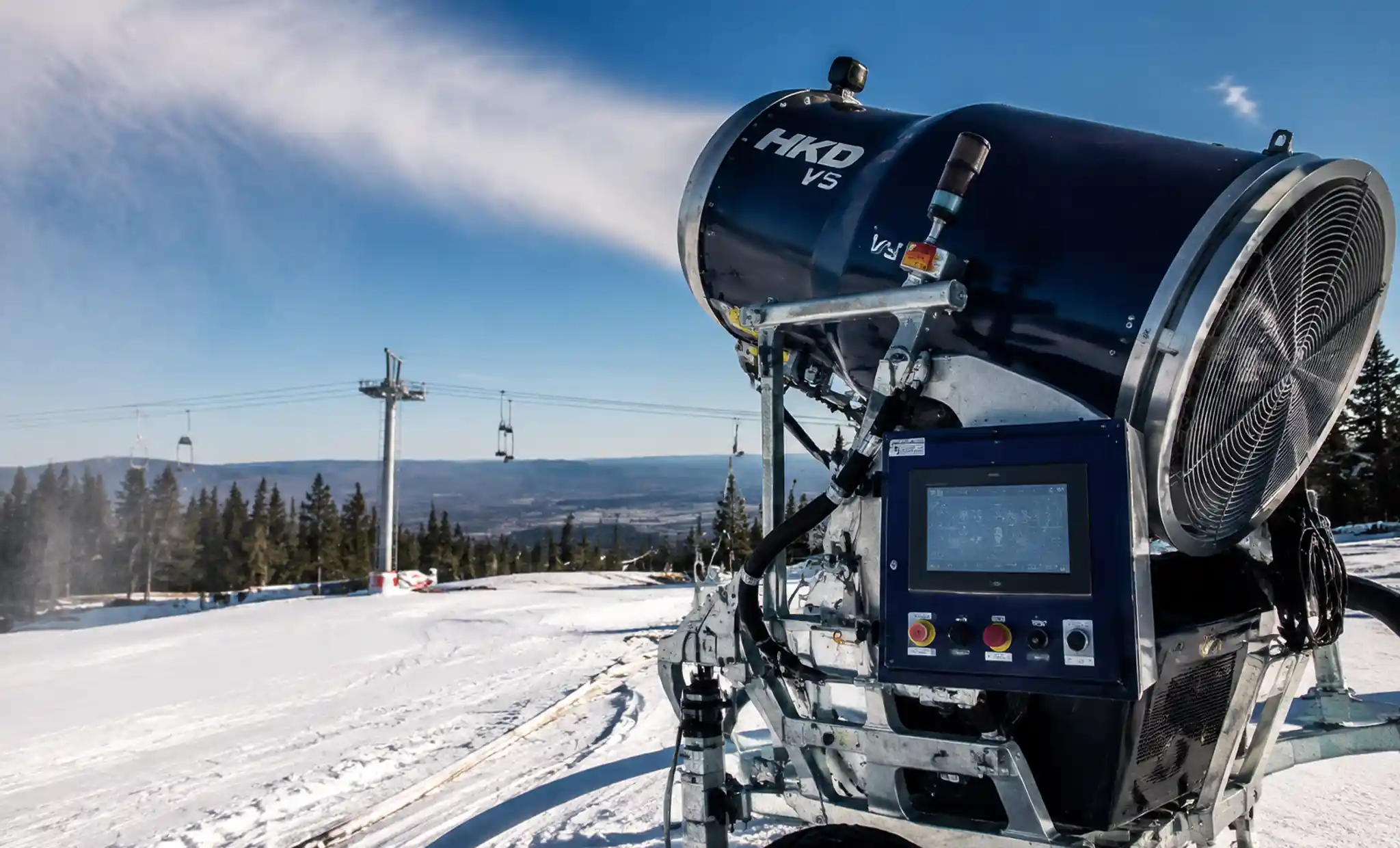
Snow Guns (Tower Guns): Freistehende, verstellbare Einheiten mit 10-30 integrierten Düsen. Flexibel für unterschiedliches Gelände.
Schneelanzen (Stick-Systeme): Feste vertikale Rohre mit Düsen entlang der Länge. Niedrigere Kosten, weniger Flexibilität, ideal für eine konstante Abdeckung.
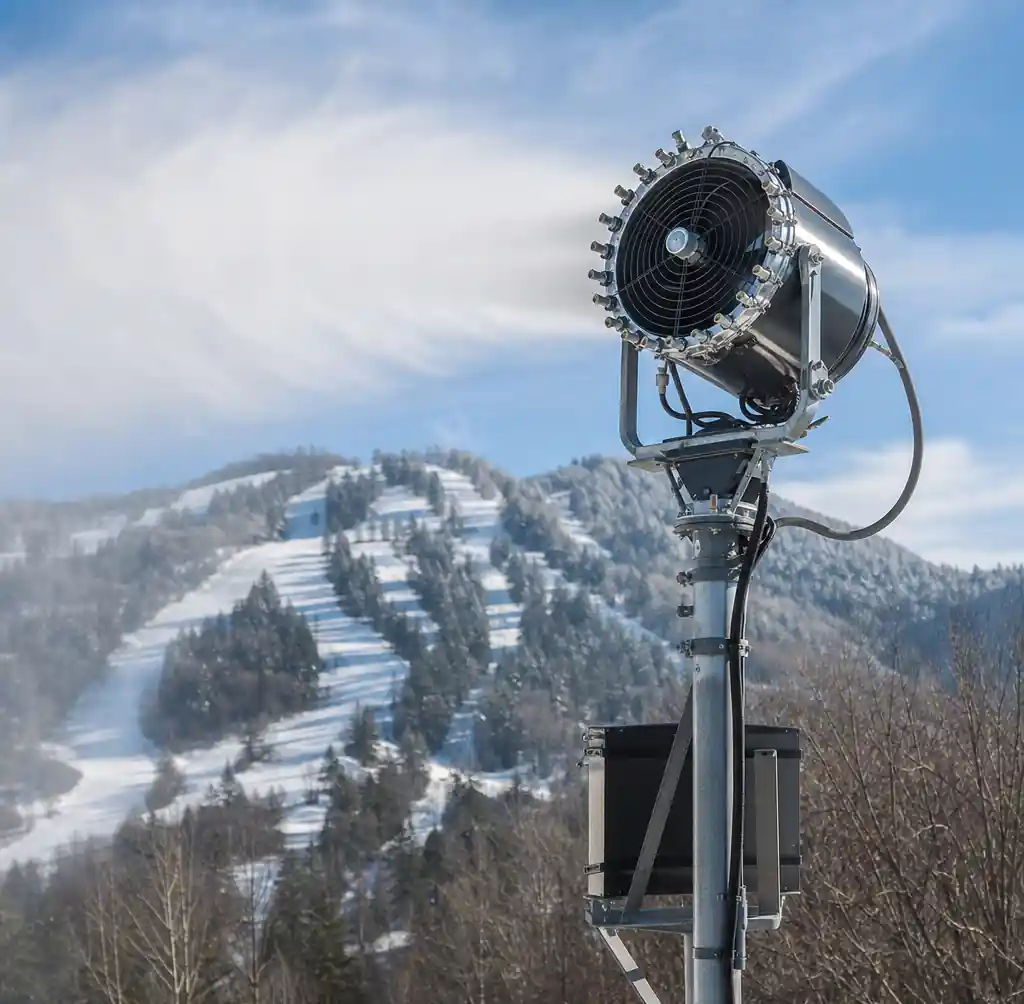
Automatisierte Lüftergewehre: Große Turmeinheiten mit Ventilatoren, die Schnee über größere Flächen treiben. Verfügen über 20–40 Düsen, die bis zu 100 Meter Windabwärts reichen.
! 7-automatisiertes-Fächer-Geschütz-Turm-System Automatisiertes Lüftergeschütz-Turmsystem mit integrierten Düsen für eine breite Abdeckung
Niedrigenergie-Turmsysteme: Minimieren oder eliminieren Sie Druckluft, reduzieren Sie die Betriebskosten um 40-60 % und erhalten Sie die Qualität.
Materialauswahl
Düsen müssen Einfrier, hohem Druck, Abrieb und Korrosion standhalten.
| Material | Lebensdauer | Am besten für |
|---|---|---|
| Edelstahl (316/316L) | 3-5 Staffeln | Professionelle Systeme, Korrosionsbeständigkeit |
| Messing | 2-3 Staffeln | Budgetsysteme |
| Keramikeinsätze | 5-7 Saisons | Strapaziantes, abrasives Wasser |
| Technische Kunststoffe | Variiert | Spezialisiert, Gewichtsreduktion |
Hartes Wasser verursacht Ablagerungen; Saures Wasser beschleunigt die Korrosion. Edelstahl mit keramischen Einsätzen bietet die beste Haltbarkeit und Präzision.
Wartung & Optimierung
Regelmäßige Wartung bewahrt die Schneequalität und -effizienz.
Vorsaison-Inspektion: Verschleiß und Öffnungsdurchmesser überprüfen. Schon 10 % Vergrößerung erhöht den Wasserverbrauch um 20 % und reduziert die Zerstäubung.
Reinigung während der Saison: Entferne wöchentlich Eis- und Mineralablagerungen. Verstopfte Keimungsdüsen verringern die Schneequalität erheblich.
Austauschplan: Messing 2-3 Saisons, Edelstahl 3-5 Saisons, Keramik 5-7 Saisons.
Leistungsüberwachung: Wasser-, Luftverbrauch und Leistung pro Düse verfolgen. Moderne Regelungssysteme liefern Echtzeitdaten.
Halten Sie den Ersatzbestand bei 10–15 % der installierten Düsen, um Ausfallzeiten zu minimieren.
FAQ
Welche Temperatur benötigt man für künstlichen Schnee?
Feuchte Kugel unter -2,5°C (27,5°F). Niedrige Luftfeuchtigkeit ermöglicht eine Schneeherstellung über 0°C (32°F).
Wie funktionieren Nukleationsdüsen?
Sie erzeugen 30–70 Mikrometer große Tröpfchen, die zu Eiskristallen einfrieren und größere Tropfen für eine schnellere Schneebildung erzeugen.
Schneepistolen vs. Schneelanzen?
Schneekanonen sind mobil mit 10–30 Düsen; Lanzen sind feste Rohre mit geringeren Kosten, aber weniger Flexibilität.
Energieverbrauch?
14.000 bis über 1,7 Millionen kWh jährlich. Hocheffiziente Düsen senken den Verbrauch um 70–80 %.
Beste Düsenmaterialien?
Edelstahl (316L) für 3-5 Saisons; Keramik-Einsätze können bis zu 5-7 Saisons ausgedehnt werden. Messing-Kost-Budgetsysteme.
Kann man über dem Gefrierpunkt Schnee erzeugen?
Ja, wenn die Luftfeuchtigkeit sehr niedrig ist. Die Produktion ist langsam und die Qualität reduziert; Der praktische Betrieb ist unter -1,1 °C (30°F) erforderlich.
Ersatzfrequenz?
Brass: 2-3 Saisons; Edelstahl: 3-5 Saisons; Keramik: 5-7 Jahreszeiten. Ersetzen, wenn sich die Öffnung über 10 % vergrößert.
Fazit
Die Schneebaudüsentechnologie kombiniert Nukleation, Atomisierung, Luft-Wasser-Mischung und Thermodynamik, um künstlichen Schnee herzustellen. Das Verständnis der Feuchtkugeltemperatur, Tröpfchenkontrolle und energieeffizientes Design optimiert die Leistung und steuert gleichzeitig die Kosten ein.
Moderne hocheffiziente Düsen bieten 70–80 % Energieeinsparungen im Vergleich zu älteren Technologien und bieten Rückzahlungszeiten von 2–4 Jahren. Die Kombination aus Nukleationsdüsen (30–70 μm) und Atomisierungsdüsen (100–500 μm) ermöglicht eine zuverlässige Schneeproduktion unter 27,5°F (-2,5°C).
Wenn Sie professionelle Schneedüsen für Ihr Skigebiet benötigen, bietet YuechenPrecision Technology präzisionskonstruierte Systeme für zuverlässige Leistung und Energieeffizienz an.
Kontaktieren Sie uns für individuelle Lösungen und technische Unterstützung.