



Wie industrielle Sprühdüsen die Behandlung von Luftverschmutzung verbessern: Ein Leitfaden für Anlagenleiter zur Einhaltung und ROI
Für Industrieanlagenleiter und Umwelt-Compliance-Ingenieure ist ein missglückter Emissionstest mehr als nur ein Warnsignal – er ist ein schneller Weg zu lähmenden EPA-Regulierungsbußen und ungeplanten, katastrophalen Ausfallzeiten. Wenn Schwefeloxide (SOx) und Stickoxide (NOx) stark ansteigen, ist der Instinkt oft, die chemischen Reagenzien oder das übergeordnete Scrub-Design zu beschuldigen. Doch in vielen Fällen ist die Hauptursache schlechter Luftverschmutzungskontrolle viel kleiner und oft übersehen: die industrielle Sprühdüse.
Die Düse ist der letzte, kritische Abgabemechanismus Ihres gesamten Emissionskontrollsystems. Wenn sie nicht richtig atomisiert, verstopft oder vorzeitig abnutzt, werden Millionen Dollar an Infrastruktur wirkungslos. In diesem umfassenden Leitfaden erfahren Sie die genaue Wissenschaft hinter der Tropfengröße, wie Sie die richtigen abgenutzten Materialien für Ihr spezifisches System auswählen und umsetzbare Strategien zur Verhinderung von Verstopfungen und zur Maximierung Ihrer Betriebs-ROI.
- 1. 1. Luftverschmutzungskontrolle verstehen: Warum Sprühdüsen die unbeachteten Helden sind
- 2. 2. Vereinfachte Kernkonzepte: Die Wissenschaft des Schrubbens und der Denitrifikation
- 2.1. Die entscheidende Rolle der Tropfengröße (Sauter-Mitteldurchmesser)
- 2.2. Systemanpassung: FGD vs. SCR/SNCR
- 2.3. Vergleichstabelle des Kernkonzepts
- 3. 3. Schritt-für-Schritt-Leitfaden zur Auswahl der richtigen Düsen für Ihr System
- 3.1. 3.1 Szenario A: Rauchgas-Entschwefelungs-(FGD-)Reiniger
- 3.2. 3.2 Szenario B: SCR- und SNCR-Denitrifizierungssysteme
- 3.3. Düsenspezifikation und Auswahldatentabelle
- 4. 4. Expertentipps und häufige Fallstricke, die man vermeiden sollte (vom Pflanzenboden aus)
- 4.1. Falle #1: Ignorieren von Maximum Free Passage (MFP) und Verstopfung
- 4.2. Falle #2: Vernachlässigung der Ausrichtung des Sprühkopfes
- 4.3. Falle #3: Auf der Suche nach billigen Ersatzleuten
- 5. 5. Fazit & Abschließende Gedanken
- 6. 6. Kurze Zusammenfassungstabelle für Entscheidungsträger
- 7. 7. Häufig gestellte Fragen (FAQ)
1. Luftverschmutzungskontrolle verstehen: Warum Sprühdüsen die unbeachteten Helden sind
Im heutigen strengen regulatorischen Umfeld, das von Organen wie der US-Umweltschutzbehörde (EPA) und der Europäischen Umweltagentur (EEA) geregelt wird, stehen Industrieanlagen unter enormem Druck, toxische Emissionen zu reduzieren. Die Faktenblätter der EPA zur Luftverschmutzungskontrolltechnologie legen klar die Notwendigkeit hocheffizienter Reinigungsmechanismen dar, um schädliche Partikel und Gase zu fangen, bevor sie in die Atmosphäre gelangen.
Ein Multi-Millionen-Dollar-Schrubbersystem ist jedoch im Grunde nutzlos, wenn das flüssige Reagenz (sei es ein Kalksteinschlamm für Schwefel oder Ammoniak für Stickstoff) nicht korrekt injiziert wird. Sprühdüsen bestimmen die genaue Oberfläche, Verteilung und Geschwindigkeit des chemischen Sprays. Sie sind die Frontsoldaten in der chemischen Reaktion, die giftige Abgase neutralisiert.
Wenn Anlagenbetreiber plötzliche Leistungseinbrüche beim Schrubben erleben, liegt das Problem oft an abgenutzten Düsenöffnungen oder ungleichmäßigen Sprühmustern. Das Verständnis der Mechanik dieser kleinen Komponenten ist der erste Schritt, um einen vollständigen Leitfaden zur Rauchgasentschwefelung (FGD) zu meistern und sicherzustellen, dass Ihre Anlage konform und profitabel bleibt.
2. Vereinfachte Kernkonzepte: Die Wissenschaft des Schrubbens und der Denitrifikation
Um fundierte Beschaffungs- und Wartungsentscheidungen zu treffen, müssen wir die Lücke zwischen komplexer Strömungsmechanik und praktischer Anlagentechnik überbrücken. Hier sind die Kernkonzepte vereinfacht.
Die entscheidende Rolle der Tropfengröße (Sauter-Mitteldurchmesser)
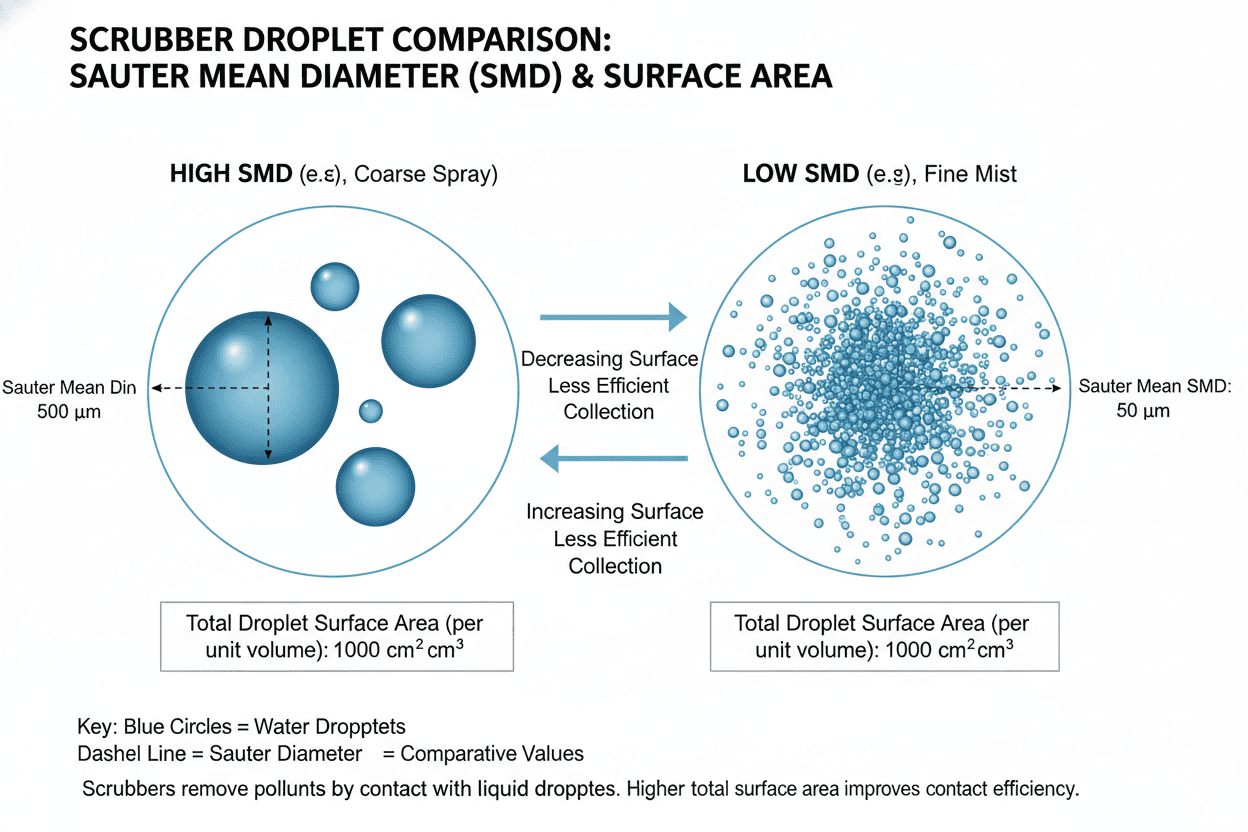
In der Welt der Sprühtechnologie wird die Tropfengröße in Sauter-Mitteldurchmesser (SMD) gemessen. Um zu verstehen, warum das wichtig ist, benutze die Analogie "Regen vs. Feinnebel".
Stell dir vor, du versuchst, einen heißen Raum abzukühlen, indem du einen Eimer Wasser (große Tropfen/Regen) in die Luft wirfst. Das Wasser trifft schnell auf den Boden und nimmt nur sehr wenig Wärme auf. Stellen Sie sich nun vor, Sie sprühen dieselbe Menge Wasser durch einen feinen Besprühventilator. Das Wasser wird in Millionen winziger Tropfen zerbrochen, wodurch eine riesige Gesamtfläche entsteht, die Wärme sofort aufnimmt.
Dasselbe Prinzip gilt für die Behandlung von Luftverschmutzung. Kleinere Tröpfchen erzeugen eine riesige Oberfläche, die es den chemischen Reagenzien ermöglicht, viel schneller und effizienter mit giftigen Gasen zu reagieren. Es gibt jedoch einen Haken: Wenn die Tröpfchen zu klein sind, wird der Hochgeschwindigkeitszug des Abgases sie wegblasen, bevor sie reagieren können, was zu verschwendungen von Chemikalien und Übertragungsproblemen führt. Die perfekte Düse findet genau die "Goldlöckchen"-Zone der Tropfengröße.
Systemanpassung: FGD vs. SCR/SNCR
Nicht alle Umweltschutzsysteme erfüllen die gleiche Aufgabe und benötigen daher völlig unterschiedliche Düsentechnologien:
- FGD (Rauchgasentschwefelung): Oft als "Schrubber" bezeichnet, wäscht dieses System Schwefeldioxid (SO2) aus, indem es eine schwere, stark abrasive Flüssigkeitsmischung (meist Wasser und Kalkstein) in das Abgase sprüht. Dafür sind große, unglaublich langlebige Düsen erforderlich.
- SCR/SNCR (Denitrifizierung): Diese Systeme beseitigen Stickoxide (NOx), indem sie einen feinen Nebel aus Ammoniak oder Harnstoff in heißes Gas injizieren. Dies erfordert hochpräzise Zerstäubungsdüsen. Das Verständnis wie industrielle Denitrifizierung funktioniert ist entscheidend, um Düsen auszuwählen, die unter extremer Hitze nicht zerfallen.
Vergleichstabelle des Kernkonzepts
| Funktion | Rauchgasentschwefelung (FGD) | SCR / SNCR Denitrifizierung |
|---|---|---|
| Zielschadstoff | Schwefeldioxid (SO2) | Stickoxide (NOx) |
| Verwendetes Reagens | Kalksteinschlamm, Meerwasser | Ammoniak, Harnstoff |
| Düsenpriorität | Verschleiß-/Abriebfestigkeit, Verstopfungsschutz | Feine Atomisierung, präzise Tröpfchengröße |
| Tröpfchengröße benötigt | Mittelgroß bis groß (um Überlagerungen zu verhindern) | Sehr fein (für schnelle Verdunstung/Reaktion) |
| Typische Umgebung | Nass, hochgradig abrasiv, korrosiv | Extrem heiß, hohe Gasgeschwindigkeit |
! Diagramm zum Vergleich von Sauter-Mitteldurchmesser und Tropfenoberfläche für Schrubber
3. Schritt-für-Schritt-Leitfaden zur Auswahl der richtigen Düsen für Ihr System
Die falsche Wahl der Düse ist ein kostspieliger Fehler. Dies führt zu verschwendung von chemischen Reagenzien, beschleunigtem Verschleiß und letztlich zu nicht bestandenen Emissionstests. Hier ist ein praktischer Leitfaden, wie Sie die richtige Wahl basierend auf Ihrem spezifischen operativen Szenario treffen.
3.1 Szenario A: Rauchgas-Entschwefelungs-(FGD-)Reiniger
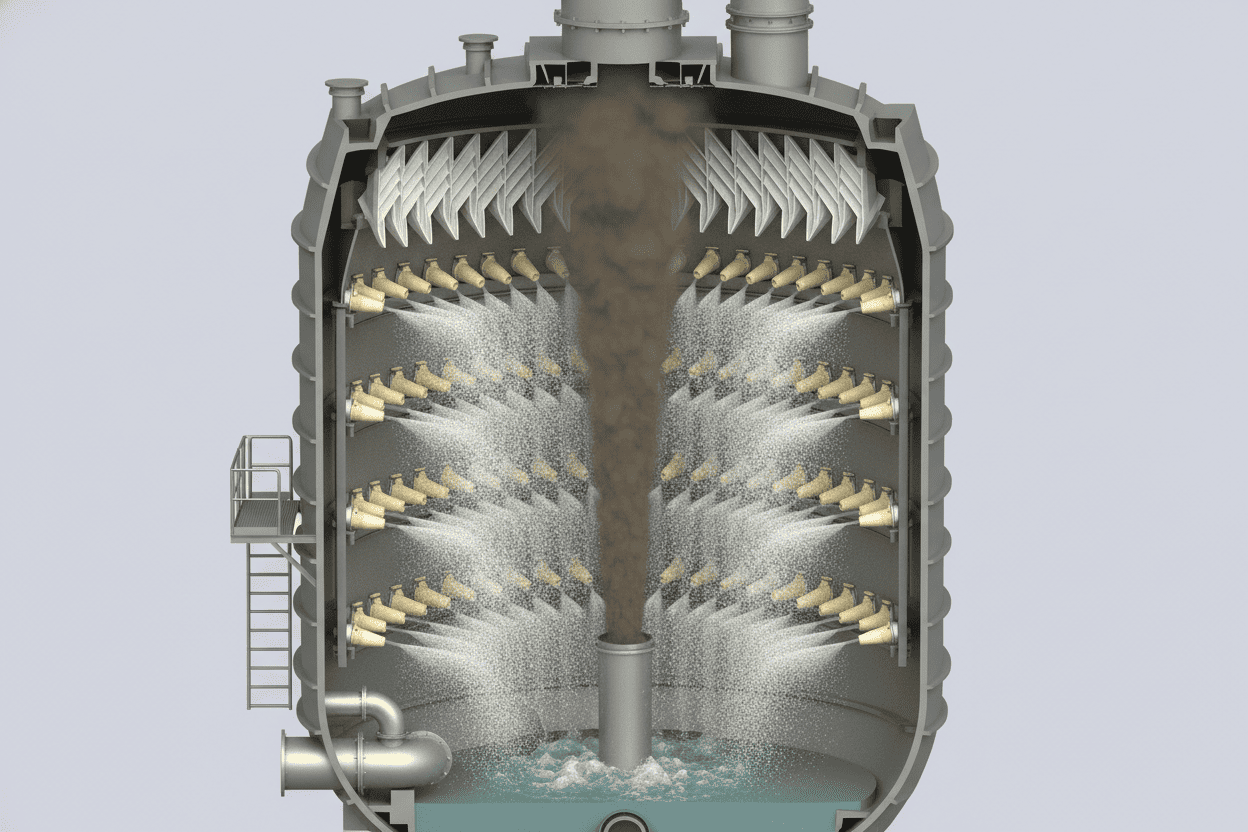
FGD-Scrubber sind brutale Umgebungen. Im Grunde pumpst du flüssiges Sandpapier (Kalksteinschlamm) kontinuierlich unter hohem Druck auf.
Das Materialauswahldilemma: Die Wahl von Düsenmaterialien für ein FGD-System ist genau wie Reifen für einen Rennwagen auswählen. Wenn man Standard-Straßenreifen auf einem Formel-1-Auto montiert, werden sie innerhalb weniger Runden zerreißen. Ähnlich gilt: Wenn Sie Standard-Edelstahldüsen in einem Kalkstein-FGD-Schrubber installieren, zerstört der abrasive Slamry die Düsenöffnung innerhalb weniger Wochen. Wenn sich die Öffnung weitet, vergrößert sich die Tropfengröße, das Sprühmuster kollabiert und SO2 gleitet direkt durch den Schornstein hinauf.
Die Lösung: Für schwere Schlammanwendungen müssen Sie in hocheffiziente FGD- und SCR-Denitrifikationsdüsen investieren, die aus fortschrittlichen Keramiken hergestellt werden, insbesondere Siliziumkarbid (SiC) oder spezialisierten hochnickelhaltigen Legierungen (wie Hastelloy). Obwohl SiC-Düsen anfangs höhere Kosten haben, ist ihre Betriebsdauer oft 5 bis 10-mal länger als die von Edelstahl, was zu einer enorm positiven ROI führt und ungeplante Ausfallzeiten für den Düsenaustausch praktisch eliminiert.
! Querschnitt eines FGD-Schrubberturms, der Siliziumkarbid-Spritzdüsen in Aktion zeigt
3.2 Szenario B: SCR- und SNCR-Denitrifizierungssysteme
Bei der Arbeit mit NOx-Emissionen verlagert sich die Herausforderung von Abschleißfestigkeit hin zu präziser Atomisierung und Temperaturkontrolle.
Verständnis der Anwendung: Um NOx effektiv in harmlosen Stickstoff und Wasser zu zerlegen, muss Ammoniak oder Harnstoff in den Abgasstrom injiziert werden. Bei SCR (Selective Catalytic Reduction) geschieht dies bei niedrigeren Temperaturen über einem Katalysatorbett. Beim SNCR (Selective Non-Catalytic Reduction) basiert es ausschließlich darauf, das Reagenz in die Hochtemperaturzone des Ofens einzubringen. Wenn Sie unsicher sind, welche für Ihre Anlage zutrifft, ist es unerlässlich, den Unterschied zwischen SCR- und SNCR-Systemen zu überprüfen.
Die Lösung: Für die Denitrifizierung braucht man Luftatomisierende Lanzen oder Doppelflüssigkeitsdüsen. Diese Düsen verwenden Druckluft, um das flüssige Reagenz in einen mikroskopisch kleinen Nebel zu zerschlagen. Wenn die Tröpfchen zu groß sind, verdampfen sie nicht, bevor sie die gegenüberliegende Wand des Kanals treffen, was zu Korrosion und verschwendungem Ammoniak (Ammoniakrutsch) führt. Präzisionstechnik ist erforderlich, um sicherzustellen, dass die Tropfengröße perfekt zur Gasgeschwindigkeit und zum Temperaturprofil Ihres spezifischen Kanals passt.
Düsenspezifikation und Auswahldatentabelle
| Systemtyp | Empfohlenes Düsenmaterial | Primärer Atomisierungstyp | Max Free Passage (MFP) Anforderung | Erwartete Lebensdauer (Optimal) |
|---|---|---|---|---|
| FGD (Kalksteinschlamm) | Siliziumkarbid (SiC), Keramik | Vollkegel, hohler Kegel | Hoch (um Schlammpartikel durchzulassen) | 3 - 5 Jahre |
| FGD (Meerwasser/Klar) | 316L Edelstahl, Hastelloy | Vollkegel | Medium | 2 - 4 Jahre |
| SCR (Ammoniakinjektion) | 310SS, Hastelloy | Luftatomisierung (Zwillingsfluid) | Niedrig (Saubere Flüssigkeiten verwendet) | 1 - 3 Jahre |
| SNCR (Harnstoffinjektion) | Hochtemperaturlegierungen | Luftatomisierung (Zwillingsfluid) | Niedrig (Saubere Flüssigkeiten verwendet) | 1 - 2 Jahre |
4. Expertentipps und häufige Fallstricke, die man vermeiden sollte (vom Pflanzenboden aus)
Selbst mit den besten Materialien und korrekter Systemabstimmung können schlechte Wartung und betriebliche Versäumnisse Ihre Abgaskontrollmaßnahmen sabotieren. Basierend auf praxisnahen Fehlerbehebungen aus Foren für Chemieingenieurwesen und Anlagenleitern sind hier die wichtigsten Fallstricke, die man vermeiden sollte.
Falle #1: Ignorieren von Maximum Free Passage (MFP) und Verstopfung
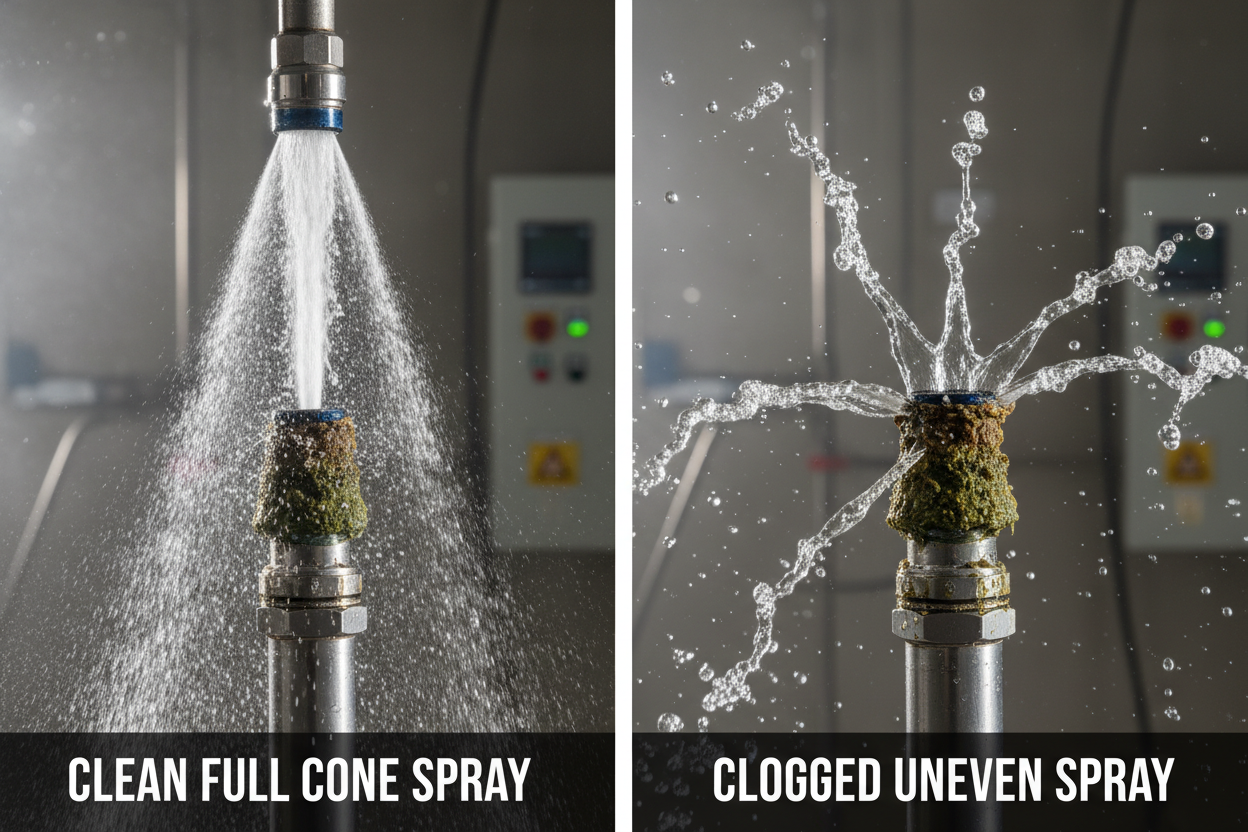
Der größte Kopfschmerz für jeden Werksleiter, der einen Nassreiniger betreibt, ist das Verstopfen der Düsen. Denken Sie an einen verstopften Duschkopf im Badezimmer zu Hause. Wenn sich Kalzium ansammelt, schießt Wasser in zufällige Richtungen heraus und hinterlässt trockene Stellen in der Dusche.
In einem Schrubber erzeugt eine verstopfte Düse eine "Gaskanalisierung". Giftiges Abgas findet von Natur aus den Weg mit dem geringsten Widerstand. Wenn eine Düse verstopft ist, entsteht ein Hohlraum in der Sprühabdeckung. Das giftige SO2 oder NOx umgeht einfach die Behandlungszone durch diesen Hohlraum und verlässt den Schornstein völlig unbehandelt.
Die Lösung: Spezifizieren Sie immer Düsen mit hohem Maximal Freidurchgang (MFP) für Schlammanwendungen. MFP bezeichnet das größte feste Partikel (wie ungemischte Kalksteinreste), das durch die Düse passieren kann, ohne festzubleiben. Spiraldüsen und große, frei durchgehende Vollkegeldüsen sind Industriestandards zur Verhinderung dieser katastrophalen Verstopfungen.
Falle #2: Vernachlässigung der Ausrichtung des Sprühkopfes
Düsen arbeiten nicht isoliert; Sie werden auf Sprühkrümmer (Gitter) installiert. Ein häufiger Fehler bei Wartungsarbeiten ist das Wiedereinsetzen der Düsen im falschen Winkel. Überlappen sich die Sprühkegel zu stark, kollidieren die Tropfen, verschmelzen zu größeren Tropfen und verlieren ihre Oberflächeneffizienz. Wenn sie nicht genug überlappen, entstehen unbehandelte Gaskanäle.
Falle #3: Auf der Suche nach billigen Ersatzleuten
Beschaffungsabteilungen suchen oft sofortige Kosteneinsparungen, indem sie generische Edelstahldüsen anstelle von konstruierten SiC oder spezialisierten Legierungen kaufen. Das ist eine falsche Wirtschaft. Die Arbeitskosten für das Abschalten eines Schrubbers, das Aufstellen von Gerüsten und den Austausch abgenutzter Düsen übersteigen bei weitem den Preis einer hochwertigen, verschleißfesten Düse. Berechnen Sie den ROI immer basierend auf den gesamten Lebenszykluskosten, einschließlich Wartungszeiten.
5. Fazit & Abschließende Gedanken
Die Einhaltung strenger Luftverschmutzungsvorschriften beruht nicht nur auf der Makro-Engineering Ihrer Anlage; Es beruht stark auf der Mikrokonstruktion deiner Sprühdüsen. Durch das Verständnis der entscheidenden Bedeutung der Tropfengröße (Sauter-Mitteldurchmesser), Investitionen in hochhaltbare Materialien wie Siliziumkarbid für abrasive Umgebungen und das aktive Management von Risiken wie Verstopfungen durch die richtige Auswahl von MFP können Anlagenleiter Ausfallzeiten und Reagenzienabfälle drastisch reduzieren.
Denken Sie daran: Ein gut optimiertes Sprühsystem ist nicht nur eine Umweltpflicht; Es ist ein bedeutender betrieblicher Vorteil, der Ihren Gewinn vor gesetzlichen Bußgeldern und übermäßigen Wartungskosten schützt.
6. Kurze Zusammenfassungstabelle für Entscheidungsträger
| Wichtige Überlegungen | Das Problem | Die Ingenieurslösung | Direkter ROI-Vorteil |
|---|---|---|---|
| Tröpfchengröße | Schlechte chemische Reaktion, verschwendete Reagenzien. | Präzise Atomisierung, die auf die Gasgeschwindigkeit zugeschnitten ist. | Niedrigere Kosten für chemische Reagenzien. |
| Abrasive Kleidung | Schnelle Düsenzerstörung bei FGD-Scrubbern. | Siliziumkarbid (SiC) oder fortschrittliche Keramiken. | Verlängerte Lebensdauer, reduzierte Wartungszeit. |
| Düse verstopft | Unbehandeltes giftiges Gas entweicht (Gaskanalisierung). | Düsendesigns mit hohem maximalem Freidurchgang (MFP). | Konsistente EPA-Konformität, keine Bußgelder. |
| Systemübereinstimmung | Falsche Düsen für NOx vs. SOx verwenden. | Doppelflüssigkeit für SCR/SNCR; Volle Kegel für FGD. | Maximale Systemeffizienz und Zuverlässigkeit. |
Bereit, Ihr Emissionskontrollsystem zu optimieren? Überprüfen Sie noch heute Ihre aktuellen Sprühköpfe, bewerten Sie Ihren Düsenverschleiß und konsultieren Sie spezialisierte Ingenieure, um Ihre Anlage auf hocheffiziente, anwendungsspezifische Düsen umzurüsten. Abonnieren Sie unseren technischen Newsletter für weitere Einblicke in industrielle Wartungs- und Compliance-Strategien.
7. Häufig gestellte Fragen (FAQ)
F1: Warum sind Sprühdüsen bei der Luftverschmutzungsbekämpfung so wichtig?
Sprühdüsen sind der endgültige Abgabemechanismus Ihres gesamten Emissionskontrollsystems. Sie bestimmen die Oberfläche, Verteilung und Geschwindigkeit der chemischen Reagenzien. Wenn eine Düse nicht richtig atomisiert, verstopft oder verschleißt, werden Millionen von Dollar an Scrubber-Infrastruktur wirkungslos – sodass giftige SOx und NOx unbehandelt entweichen können.
F2: Was ist der Sauter-Mitteldurchmesser (SMD) und warum ist er entscheidend?
SMD ist die durchschnittliche Tröpfchengröße, die von einer Düse erzeugt wird. Kleinere Tröpfchen schaffen eine riesige Oberfläche für schnellere chemische Reaktionen mit giftigen Gasen. Sind Tröpfchen jedoch zu klein, wird sie durch die Abgasgeschwindigkeit vor der Reaktion (Carry-Over) weggeblasen. Die rechte Düse trifft die "Goldlöckchen"-Zone – klein genug, um effizient zu reagieren, groß genug, um im Gasstrom zu bleiben.
F3: Kann ich Standard-Edelstahldüsen in einem FGD-Schrubber verwenden?
Nein. Kalksteinschlamm ist im Grunde flüssiges Schleifpapier. Standard-Edelstahldüsen verlieren innerhalb weniger Wochen ihre Öffnungen, was zu einem Sprühmusterkollaps und SO2-Lecks führt. Für FGD-Systeme müssen Sie Siliziumkarbid (SiC) oder spezialisierte hochnickelhaltige Legierungen wie Hastelloy verwenden – diese halten 5–10-mal länger und liefern einen positiven ROI.
F4: Was ist Maximum Free Passage (MFP) und warum verhindert es Verstopfungen?
MFP ist das größte feste Teilchen, das durch eine Düse passieren kann, ohne sich zu blockieren. In Schlammanwendungen können ungemischte Kalksteinreste oder Rohrkalk Standarddüsen blockieren, wodurch eine "Gaskanalisierung" entsteht, bei der unbehandeltes giftiges Gas die Behandlungszone umgeht. Hoch-MFP-Spiral- oder große, frei durchlaufende Vollkegeldüsen sind unerlässlich, um dies zu verhindern.
F5: Woran erkenne ich, ob meine Düsen abgenutzt sind und ersetzt werden müssen?
Verwende ein Go/No-Go-Messgerät, um den Durchmesser der Öffnung zu überprüfen. Wenn die Öffnung um mehr als 10 % der Konstruktionsspezifikation vergrößert ist, ersetzen Sie sie sofort. Weitere Warnzeichen sind: ungleichmäßige Sprühmuster, erhöhter Reagenzienverbrauch, steigende Emissionswerte und häufige Druckschwankungen im Header-System.